

UK Late Payment Interest: 8% + Bank Rate Calculator
Check the current statutory rate, whether your unpaid business invoice qualifies, and the interest and compensation you may be able to charge.
Current Jul–Dec 2026 reference
11.75% per year
8% statutory uplift + 3.75% Bank Rate recorded on 30 June 2026. Use this only for an eligible B2B debt that became late from 1 July to 31 December 2026.
Independent guide. Confirm the applicable period and your contract before charging interest. The calculator needs no account.
Quick Answer
Current answer: for an eligible UK B2B debt that became late from 1 July to 31 December 2026, the statutory rate is 11.75% per year. It starts from the day after the payment due date and is calculated daily on the overdue amount.
For an eligible UK B2B debt that became late from 1 July to 31 December 2026, the statutory rate is 11.75% per year: the 8% statutory uplift plus the 3.75% Bank of England reference rate recorded on 30 June 2026. The scheme uses the rate on 31 December for January–June and on 30 June for July–December, so check when the debt became late and whether the contract sets a different rate. See the Small Business Commissioner's reference-rate guidance before relying on a calculation.
You can also claim fixed compensation of £40, £70, or £100 depending on the debt size. If the contract sets a different interest rate, you cannot also claim statutory interest.
Use the late payment interest calculator before sending a final reminder or Letter Before Action.
Check before calculating
Does statutory late-payment interest apply?
The invoice is for goods or services supplied to another business or a public authority.
The agreed payment date has passed, or the default payment period has ended.
The contract does not already set a different interest rate that replaces the statutory rate.
You have checked the reference-rate period that applied when this debt became late.
Statutory interest formula
Debt × (Bank Rate + 8%) × days overdue ÷ 365
For illustration, with an applicable reference rate of 3.75%, a £1,000 invoice that is 30 days late accrues approximately £9.66 in statutory interest: £1,000 × 11.75% × 30 ÷ 365. Check the applicable reference rate and your contract before relying on the result.
The Late Payment of Commercial Debts Act 1998
For qualifying commercial debts, the Act implies a right to charge statutory interest when another business pays late. You do not need to agree the statutory right upfront. The eligibility and current calculation are explained in the GOV.UK late commercial payments guidance. A different contractual interest rate replaces the statutory rate.
The regime can apply to qualifying B2B contracts for goods or services across the UK. It does not apply to consumer sales or transactions with individuals acting outside their business. Check the contract and the nature of the debt before relying on it.
How Much Interest Can You Charge?
The statutory rate is 8% per annum above the Bank of England base rate. Interest is calculated on a simple (not compound) basis.
Calculation Example
- Invoice amount: £5,000
- Assumed applicable reference rate: 3.75% (illustrative)
- Statutory rate: 8% + 3.75% = 11.75% per annum
- Daily interest: £5,000 × 11.75% ÷ 365 = £1.61 per day
- 30 days overdue: £48.29
Fixed Compensation Amounts
On top of interest, you can claim a fixed compensation payment for the inconvenience of chasing the debt:
| Debt Amount | Compensation |
|---|---|
| Up to £999.99 | £40 |
| £1,000 – £9,999.99 | £70 |
| £10,000 or more | £100 |
The fixed sum can be charged once for each qualifying late payment, not per day. You can also recover reasonable debt recovery costs if the fixed sum doesn't cover them.
When Does Interest Start?
Interest accrues from the day after the payment due date. If your invoice doesn't specify a due date, the default period is 30 days from either:
- 📅 The date the customer receives the invoice, or
- 📅 The date you delivered the goods or completed the service (whichever is later)
Always set clear payment terms on your invoices (e.g. "Payment due within 14 days") to avoid ambiguity.
How to Charge Late Payment Interest
- State your policy on the original invoice - include a line such as "Late payments will incur statutory interest at 8% above the Bank of England base rate plus fixed compensation under the Late Payment of Commercial Debts Act 1998."
- Send a reminder when the invoice becomes overdue - note the outstanding amount, the overdue period, and the interest that is accruing.
- Issue a supplementary invoice or statement - listing the original debt, the interest calculated to date, and the fixed compensation amount.
- Keep records - log the Bank of England base rate you used, the number of days overdue, and all correspondence.
Proposed 2026 Late Payment Reforms
As of 26 September 2026, Parliament lists the Commercial Payments Bill as HL Bill 55, as amended on Report on 15 September 2026. It has not reached Royal Assent, so the measures below remain proposed and are not yet in force. See the current UK Parliament bill page and the official Commercial Payments Bill overview.
- 🔹 Maximum payment terms - the Bill would impose a 60-day maximum, with limited exemptions.
- 🔹 Mandatory late-payment interest - the Bill would make interest at 8% above Bank Rate mandatory for qualifying late commercial payments.
- 🔹 Small Business Commissioner powers - the Bill would add investigation, adjudication, direction, and financial penalty powers.
- 🔹 Reporting and scrutiny - planned secondary legislation would expand reporting by large businesses and require commentary from persistently late-paying companies.
💡 Practical Tip
State the applicable interest terms clearly on the invoice and in the contract. Before adding statutory interest, confirm that the contract does not already specify a different rate and check the applicable reference rate for the debt.
Evidence checked 26 September 2026
Official sources behind this guide
Experi is not a government body or legal adviser. This page is practical information, not legal advice; use the official sources or obtain professional advice for disputed or unusual debts.
Frequently Asked Questions
What is the UK statutory late payment interest rate from July to December 2026?
For an eligible UK B2B debt that became late from 1 July to 31 December 2026, the statutory rate is 11.75% per year: the 8% statutory uplift plus the 3.75% Bank of England reference rate recorded on 30 June 2026. The scheme uses the rate on 31 December for January–June and on 30 June for July–December, so check when the debt became late and whether the contract sets a different rate.
How do I calculate statutory late payment interest?
Multiply the overdue debt by the applicable annual statutory rate, multiply by the number of days overdue, then divide by 365. For an eligible debt that became late from 1 July to 31 December 2026, use 11.75% as the annual rate.
How much fixed compensation can I claim for a late payment?
You can claim £40 for debts under £1,000, £70 for debts between £1,000 and £9,999.99, and £100 for debts of £10,000 or more. GOV.UK says the fixed sum can be charged once for each qualifying late payment.
Does late payment interest apply to consumer invoices?
No. Statutory late payment interest under the Late Payment of Commercial Debts Act 1998 only applies to business-to-business (B2B) transactions. Different consumer credit rules apply to B2C debts.
Do I need to mention late payment interest on my invoice to claim it?
You do not have to state statutory interest on the invoice for the statutory right to apply. However, you cannot claim statutory interest if the contract sets a different interest rate, so clear wording matters.
What are the 2026 late payment reforms?
The Commercial Payments Bill was introduced to Parliament in May 2026. Its measures are proposed and are not yet in force; the government says there will be a transition period before the new rules apply.
From overdue invoice to a considered next step
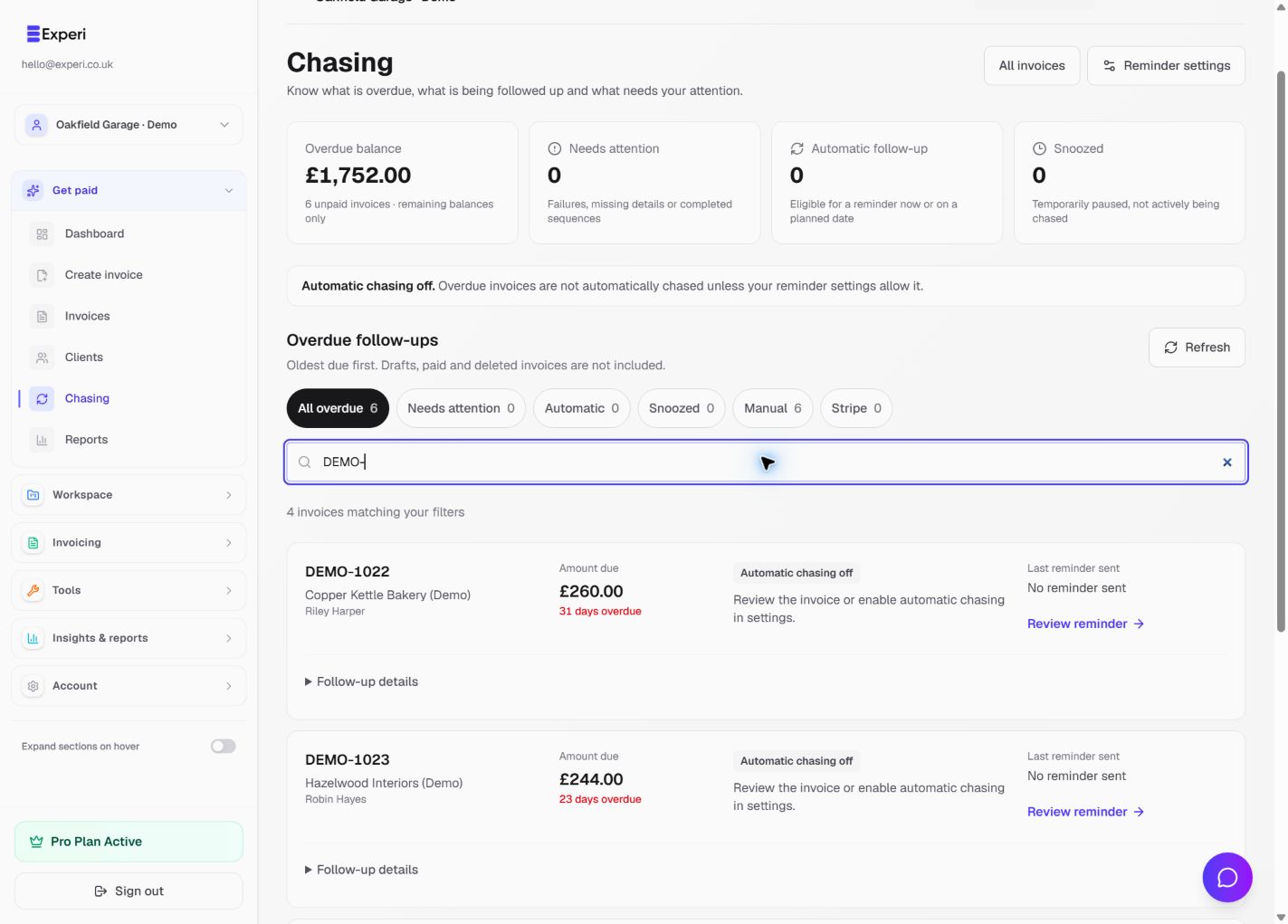
Use Chasing to check the balance and reminder history, then choose Escalate chasing on Pro. Keep reviewed letters, sending records and supporting documents with the invoice.
- Check that the invoice is still unpaid and review any dispute or payment received outside Experi. Opening Chasing does not send a reminder.
- Choose a payment reminder, final reminder or Letter Before Action. Edit the letter in Experi, check the recipient and applicable requirements, then approve a fixed copy to download as PDF or print.
- Arrange delivery yourself, record when and how you sent it, and upload proof of posting or correspondence. Recording sending does not post or email the letter.
Need the calculation first? Use the free late-payment calculator. Experi does not post letters, file claims or guarantee legal compliance.