

MCOL Explained: Meaning, Official Links, Fees & Process
Use the right government service, then check eligibility, fees and evidence for an unpaid-invoice claim.
MCOL means Money Claim Online. It is HM Courts and Tribunals Service's long-standing service for eligible fixed-sum county court claims. For a new claim, start at GOV.UK so it can route you to the correct service.
Preparing an unpaid invoice claim? Jump to the evidence checklistExperi is an independent guide. It is not HMCTS or GOV.UK. Filing a claim costs a fee and does not guarantee payment.
Before You Start an MCOL Claim
MCOL should usually come after a documented chasing process, not as your first follow-up. Start with a polite reminder, then a firmer chasing email, then a formal Letter Before Action.
Use our chasing letter templates and late payment calculator to prepare the evidence and claim amount before filing.
What Is Money Claims Online?
Money Claim Online (MCOL) is an HM Courts and Tribunals Service for issuing money claims. The current public starting point is the GOV.UK Make a court claim service, which routes claimants to the appropriate online service or paper process for their circumstances.
Do not rely on an old MCOL checklist or direct link alone. Check the current GOV.UK route before filing because service limits, help with fees, and the process can change.
Check the Current Online Route
GOV.UK says you can usually make a money claim online when the amount is known. Before filing, confirm that:
- ✅ You know the amount you want to claim
- ✅ You have the defendant's name, address, and email address where available
- ✅ The defendant is not currently protected from creditors by the Breathing Space scheme
- ✅ You have checked whether your circumstances require the online service, a paper claim, or legal advice
- ✅ You have already sent a Letter Before Action and allowed the response period that applies to the claim
A 30-day reply period applies when the Pre-Action Protocol for Debt Claims covers a business creditor's claim against an individual, including a sole trader. Other business debts can follow different pre-action requirements, so check which protocol or practice direction applies.
Claims of £10,000 or less are usually allocated to the small claims track. Larger or complex claims use a more formal process, so consider legal advice before filing.
What You Need Before Filing
Gather the following before starting your claim:
- 📄 Defendant's full name and address - for a company, use the registered office address (check Companies House)
- 📄 Your Letter Before Action - and evidence it was sent (posting receipt, email timestamp)
- 📄 Invoice(s) - showing the amount, date, and payment terms
- 📄 The claim amount - the original debt plus only the interest and recovery costs you are entitled to claim
- 📄 Brief particulars of claim - a concise explanation of why the money is owed
- 📄 A debit or credit card or help-with-fees reference - to deal with the court fee online
💡 Calculating Your Claim Amount
Your total claim may include the original invoice amount, plus statutory interest (8% + BoE base rate, calculated to the date of filing) and fixed compensation (£40/£70/£100), if those remedies apply. A different contractual interest rate replaces statutory interest. Use our late payment calculator to prepare an estimate, then check the basis and figures before filing.
From overdue invoice to a considered next step
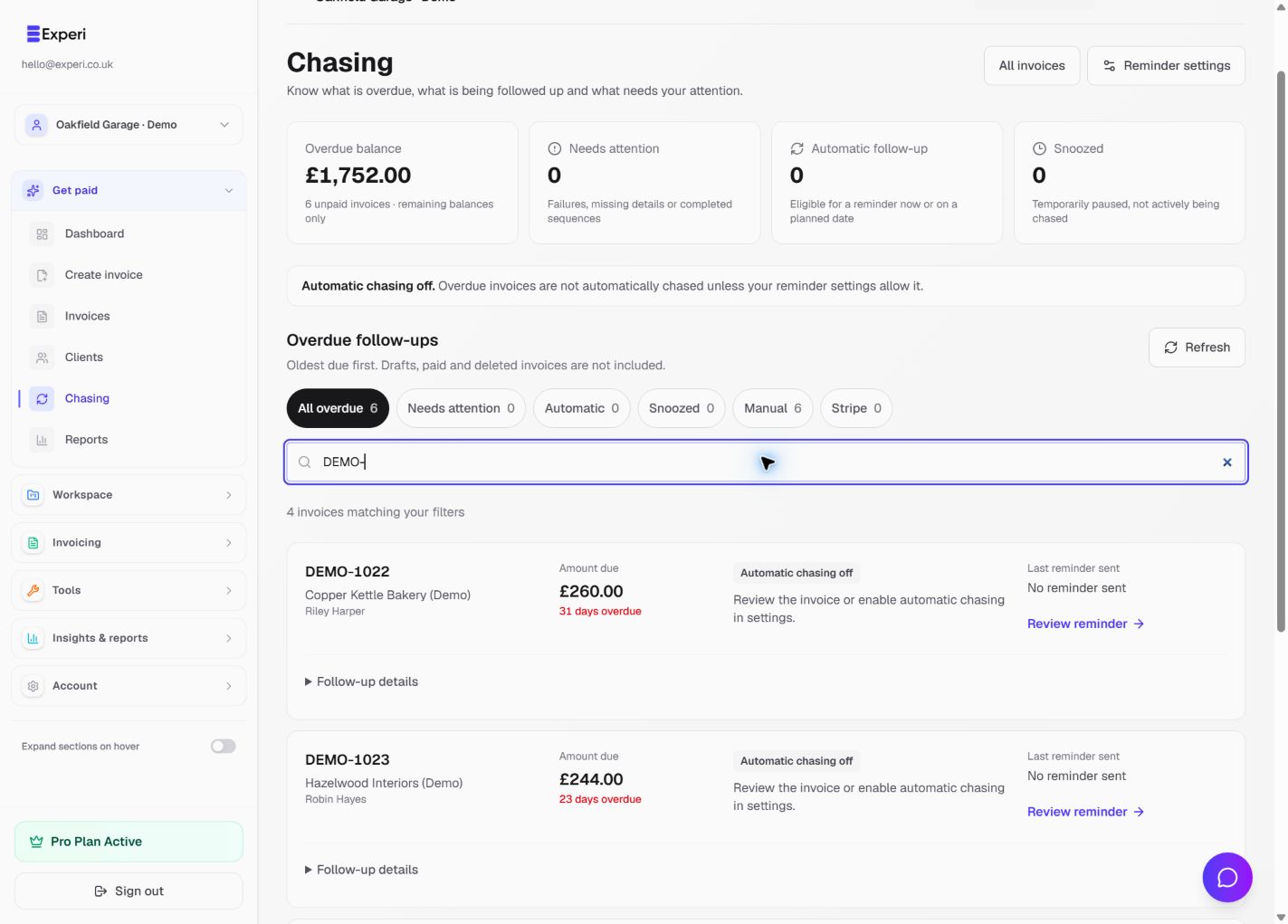
Use Chasing to check the balance and reminder history, then choose Escalate chasing on Pro. Keep reviewed letters, sending records and supporting documents with the invoice.
- Check that the invoice is still unpaid and review any dispute or payment received outside Experi. Opening Chasing does not send a reminder.
- Choose a payment reminder, final reminder or Letter Before Action. Edit the letter in Experi, check the recipient and applicable requirements, then approve a fixed copy to download as PDF or print.
- Arrange delivery yourself, record when and how you sent it, and upload proof of posting or correspondence. Recording sending does not post or email the letter.
Need the calculation first? Use the free late-payment calculator. Experi does not post letters, file claims or guarantee legal compliance.
Money Claim Online Court Fees
| Claim Amount | Online Court Fee |
|---|---|
| Up to £300 | £35 |
| £300.01 – £500 | £50 |
| £500.01 – £1,000 | £70 |
| £1,000.01 – £1,500 | £80 |
| £1,500.01 – £3,000 | £115 |
| £3,000.01 – £5,000 | £205 |
| £5,000.01 – £10,000 | £455 |
| £10,000.01 – £200,000 | 5% of the claim |
| More than £200,000 | £10,000 |
You may be able to recover the court fee if you win. Check the current fee before filing because later hearing or enforcement fees may also apply.
Fees checked against GOV.UK on 26 September 2026. You cannot use the online service when you do not know the amount you want to claim.
Money Claim Online Process: Step by Step
Step 1: Create an Account
Start at GOV.UK's Make a court claim service. Answer the eligibility questions and follow the route it gives you; you'll need an email address to receive updates.
Step 2: Enter Your Details
Enter your name and address (or your business name and registered address). This is the claimant information.
Step 3: Enter the Defendant's Details
Enter the defendant's full name and address. For a limited company, use the exact registered name from Companies House and the registered office address.
Step 4: Enter the Claim Amount
Enter the total amount you're claiming: the original debt plus any applicable interest and fixed compensation. The online service calculates the court fee separately.
Step 5: Write the Particulars of Claim
Describe briefly why the money is owed. Include the invoice number, date, work or goods supplied, payment terms, and the legal basis for any interest or compensation you include.
Step 6: Pay the Court Fee
Pay the fee by debit or credit card. Once payment is confirmed, the court issues the claim and sends it to the defendant.
MCOL Particulars of Claim Example for an Unpaid Invoice
The particulars explain the facts that give rise to the debt. The MCOL form allows a maximum of 1,080 characters, including spaces. If that is not enough, Practice Direction 7C allows detailed particulars to be served separately, with extra filing and service steps.
Illustrative structure
The claimant supplied [goods or services] to the defendant under an agreement dated [date]. Invoice [number] for £[principal] was issued on [invoice date] and fell due on [due date]. The defendant has not paid despite reminders and a pre-action letter dated [date]. The claimant claims £[principal], interest under [contract or legislation] of £[interest] to [filing date], continuing interest at [daily rate] where applicable, the court fee, and any other sum the court allows.
Replace every bracketed field and describe what actually happened. Do not claim interest, compensation or costs without a valid basis. The Civil Procedure Rules require concise facts and details of the basis for any interest claimed. This example is a drafting aid, not wording for every dispute.
Money Claim Online Timeline at a Glance
| Stage | Typical timing | What to check |
|---|---|---|
| Pre-action | Before filing | Send the appropriate letter and allow the applicable response period. |
| Issue and service | Claim is deemed served on the fifth day after issue under the MCOL practice direction. | Keep the issue date and notice from the court. |
| Response | Usually 14 days after service, extended to 28 days if an acknowledgment of service is filed. | The defendant may pay, admit, part-admit, defend or acknowledge. |
| No response | After the response deadline | You may request default judgment. It is not entered automatically. |
| Defence or enforcement | Depends on the response and court directions | A defended claim may move to mediation or a hearing. A judgment may still need separate enforcement. |
What Happens After Filing
For MCOL, the claim is normally treated as served on the fifth day after issue. The defendant then normally has 14 days after service to respond, or 28 days after service if they file an acknowledgment of service. There are four possible outcomes:
Defendant Admits the Claim
They accept they owe the money and may propose a payment plan. You can accept their proposed terms or ask the court to decide how payment should be made.
Defendant Part-Admits
They accept part of the debt but dispute the rest. You can accept the partial admission or continue with the full claim. The disputed portion goes to a hearing.
Defendant Defends
The case is allocated to a track (small claims for under £10,000) and a hearing date is set. Both sides submit evidence, and a judge decides. See our small claims court guide for what to expect.
Defendant Ignores the Claim
If the defendant does not respond within the deadline, you may request default judgment. It is not automatic: HMCTS warns that a response received before the request is processed can take priority.
Default Judgment
If the defendant doesn't respond, you can request a default judgment through your online claim account. You choose whether payment should be made in full immediately or in instalments. Check the claim status before requesting judgment because a late response may have been recorded. If judgment is entered, the court issues a County Court Judgment (CCJ) ordering the defendant to pay.
Enforcement After Winning
Getting a judgment doesn't guarantee payment. If the defendant still doesn't pay after the CCJ, you can use enforcement methods:
- ⚖️ Warrant of control (bailiffs) - county court bailiffs or High Court Enforcement Officers visit the debtor
- ⚖️ Attachment of earnings - deductions directly from the debtor's wages
- ⚖️ Charging order - a legal charge placed on the debtor's property
- ⚖️ Third-party debt order - freezes money in the debtor's bank account
Each enforcement method has its own rules and application fee. Some fees may be added to the amount owed, but enforcement still does not guarantee recovery, so compare the cost with what is known about the debtor's ability to pay.
Frequently Asked Questions
What is Money Claims Online (MCOL)?
MCOL stands for Money Claim Online, an HM Courts and Tribunals Service for issuing money claims. GOV.UK now starts claimants at its Make a court claim service and routes them to the appropriate online or paper process.
Can I use MCOL for an unpaid invoice?
Yes, if the invoice debt is a fixed amount and the claim meets the service rules. You should chase the invoice first and send a Letter Before Action before filing the claim.
Is MCOL the same as small claims court?
MCOL is the online service used to start a money claim. Claims up to £10,000 are usually allocated to the small claims track, but MCOL itself can handle fixed money claims above that amount too.
How much does it cost to file a claim on MCOL?
Online fees range from £35 for claims up to £300 to £455 for claims between £5,001 and £10,000. The fee is 5% for claims between £10,000.01 and £200,000. You may be able to recover the court fee if you win.
What happens if the defendant doesn't respond?
The usual deadline is 14 days after service, or 28 days after service if an acknowledgment is filed. If no response is recorded after the deadline, you may request default judgment. It is not automatic, and a response received before HMCTS processes the request can take priority.
Can I use MCOL for claims over £10,000?
The current GOV.UK service can accept online claims over £10,000 in many circumstances. These claims are not normally allocated to the small claims track, so the process is more formal and you should consider legal advice.
Do I need a solicitor to use MCOL?
No. MCOL is designed so individuals and small businesses can file claims themselves. For claims on the small claims track (up to £10,000), the process is informal and you're expected to represent yourself.
Prepare Your Court Claim with Experi
Experi keeps the invoice, reminder history, reviewed recovery letters and payment records together. Its calculator can prepare an interest and compensation estimate for you to check before deciding what to claim.