UK Late Payment Regulations 2026: Bill Status & Rules
The Commercial Payments Bill could change payment terms, interest, disputes and enforcement. It is not law yet. Here is what applies today and what remains proposed.
Bill status
Lords third reading
Report stage finished on 15 September. Third reading is scheduled for 20 October 2026 and may change.
Legal effect today
Not yet in force
Use the current Late Payment of Commercial Debts rules until any new provisions are enacted and commenced.
Current answer: there are no new UK late-payment regulations in force from the Commercial Payments Bill as at 26 September 2026. The Bill is at Lords third reading. Current law still governs payment dates, statutory interest and compensation.
What applies now vs what the Bill proposes
In force today
Current late-payment rights
Eligible B2B suppliers can claim statutory interest at 8% above the applicable Bank of England reference rate.
Fixed compensation may be claimable. It is not automatically paid, so eligibility and the contract still need checking.
Without an agreed date, payment is normally late after 30 days. Longer private-sector terms can be agreed where fair.
A different contractual remedy can replace statutory interest if it is a substantial remedy for late payment.
The current text would generally require a commercial contract to make a relevant payment due within 60 days for a private purchaser, or 30 days for a public authority. If a contract has no valid payment term, the Bill would imply a 30-day term.
That is more nuanced than a blanket promise that every freelancer will always be paid within 60 days. The Bill contains exemptions and regulation-making powers, including definitions based on business size. Final coverage will depend on the enacted text and later rules.
2. Statutory interest
Current law lets eligible suppliers claim statutory interest, but a contract can instead provide a different substantial remedy. The Bill would make statutory interest an implied term and make a term void so far as it excludes or varies that right.
Until that change is enacted and commenced, use the current rules. For eligible debts becoming late from July to December 2026, the statutory annual rate is 11.75%: the 8% uplift plus the 3.75% reference rate recorded on 30 June 2026.
3. Late or unclear disputes
The Bill as amended on Report proposes a fixed sum of at least £40 where a purchaser raises a relevant dispute after the last dispute day, or does not provide enough information by then. The last dispute day is tied to the payment date rather than a universal 30-day window.
4. Commissioner powers and construction retentions
The Bill would create an adjudication scheme and expand the Small Business Commissioner's investigation and enforcement powers. It also contains a phased route to banning retention clauses in relevant construction contracts. Those powers do not exist in their proposed final form today.
What a freelancer or small supplier should do now
Use the law in force today. Check that the debt is a qualifying B2B debt and review any contractual interest clause.
Confirm the correct due date. Keep the invoice, agreed terms, proof of delivery and any acceptance or dispute trail.
Estimate the current claim. Use the free late-payment calculator for a transparent interest and compensation estimate.
Chase proportionately. Start with a clear reminder, address genuine disputes and preserve a record before escalating.
Check the live Bill before planning around reform.The wording, timetable, exemptions and commencement can still move.
Useful today
Work from the current rules, not a future promise
Estimate interest and compensation for an eligible overdue B2B invoice, then check the assumptions before using the result. The calculator needs no account and does not send anything.
Commercial Payments Bill introduced in the House of Lords.
21 July 2026
Lords committee stage completed.
15 September 2026
Lords report stage completed; HL Bill 55 published.
20 October 2026
Lords third reading scheduled. Parliament marks future dates as provisional.
Not confirmed
Commons stages, Royal Assent and most commencement dates.
Frequently asked questions
When do the UK late payment reforms come into effect?
They do not have a confirmed commencement date. As at 26 September 2026, the Commercial Payments Bill is in the House of Lords and third reading is scheduled for 20 October 2026. That date is provisional. The Bill must complete Parliament and receive Royal Assent, and most measures would then start on dates appointed by regulations.
What does the Bill say about 60-day payment terms?
The Bill as amended on Report would generally cap payment terms at 60 days where the purchaser is not a public authority and 30 days where it is. It also provides for exemptions and detailed definitions to be set by regulations. These proposed limits are not yet in force.
Can I charge statutory late-payment interest now?
For an eligible UK business-to-business debt, current law lets a supplier claim statutory interest at 8% above the applicable Bank of England reference rate and fixed compensation. A contract that provides a different substantial remedy can displace the statutory rate, so check the contract and eligibility before claiming.
Would the Bill make late-payment interest mandatory?
The current Bill would make statutory interest an implied contract term and make terms that exclude or vary that right void. That is a proposal in a Bill, not the rule in force today, and the text can still change.
What would happen if a purchaser raises a dispute late?
The current Bill proposes a fixed sum if a purchaser raises a relevant dispute after the last dispute day or does not provide enough information by that day. It does not say that a late dispute automatically disappears or that the invoice is deemed accepted.
Do the proposed rules cover freelancers and sole traders?
A freelancer or sole trader can be a supplier under a commercial contract, but business form alone does not decide how every measure would apply. The contract, purchaser, any exemption and future regulations would matter. Check the final Act and commencement rules before relying on a proposed protection.
From overdue invoice to a considered next step
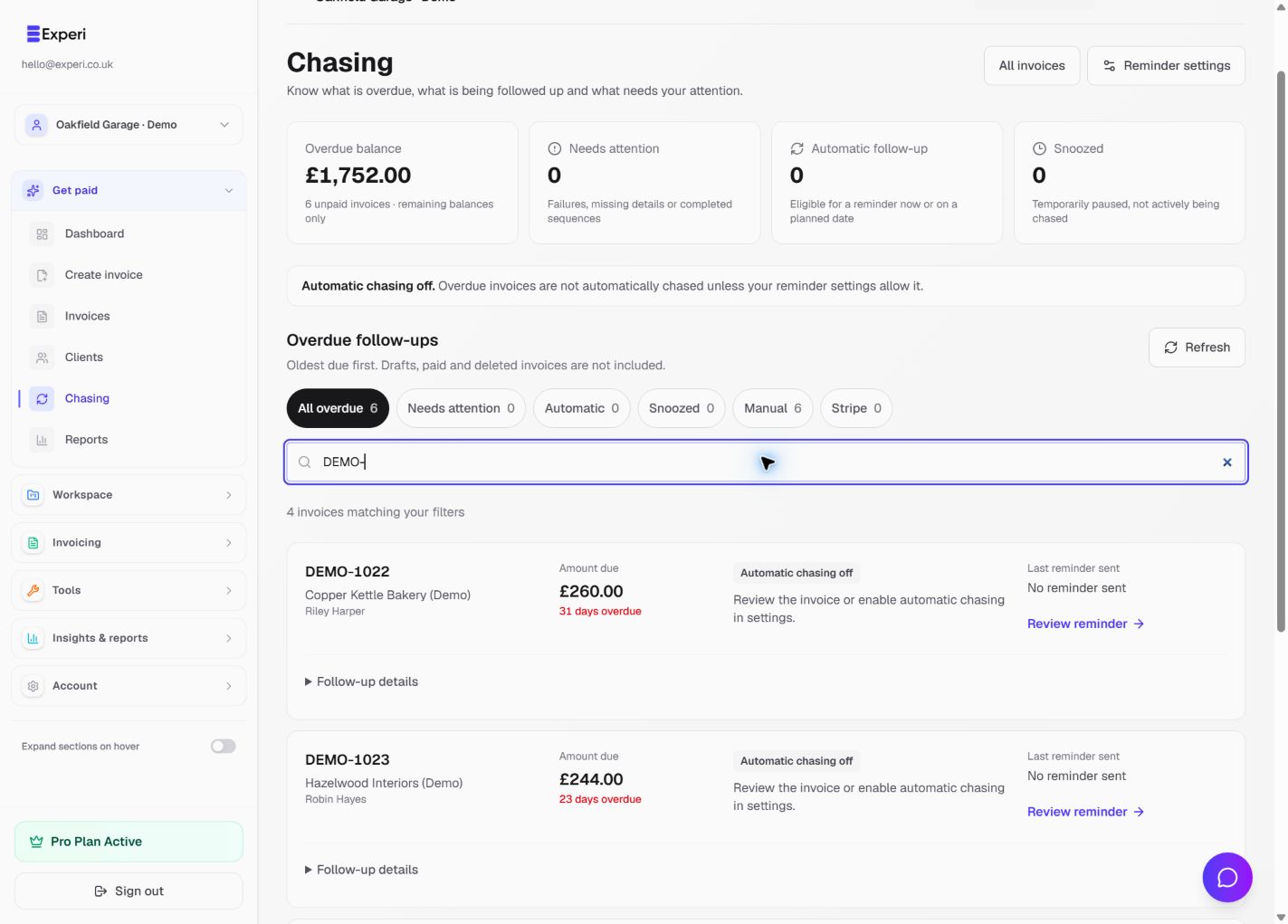
Use Chasing to check the balance and reminder history, then choose Escalate chasing on Pro. Keep reviewed letters, sending records and supporting documents with the invoice.
Check that the invoice is still unpaid and review any dispute or payment received outside Experi. Opening Chasing does not send a reminder.
Choose a payment reminder, final reminder or Letter Before Action. Edit the letter in Experi, check the recipient and applicable requirements, then approve a fixed copy to download as PDF or print.
Arrange delivery yourself, record when and how you sent it, and upload proof of posting or correspondence. Recording sending does not post or email the letter.
See the next follow-up. Review overdue invoices and the next follow-up. Search filters the rows while summary cards describe the workspace.